← All verticalsElectronics & repair POS
Find any device you ever sold in one click.
A customer brings back a faulty phone six months later — type the IMEI and the original order, customer, and warranty status are one click away. Every phone, tablet, laptop, TV, and camera body is per-unit tracked by IMEI or serial, and repair tickets and trade-ins link to the device, not the SKU.
$29 / store / monthMulti-store on every planWorks offline5-minute setup
What's in the Electronics starter
- •8 categories: Phones, Tablets, Laptops, TVs & displays, Audio, Cameras, Accessories, Repair & care.
- •~40 items pre-loaded — flagship + mid-range phones, tablets, laptops up to 16in pro, OLED TVs, mirrorless & DSLR camera bodies, lenses, headphones, plus 10 accessories.
- •Per-unit serial tracking on every phone, tablet, laptop, TV, camera body, lens, and premium audio device. Accessories stay on integer stock.
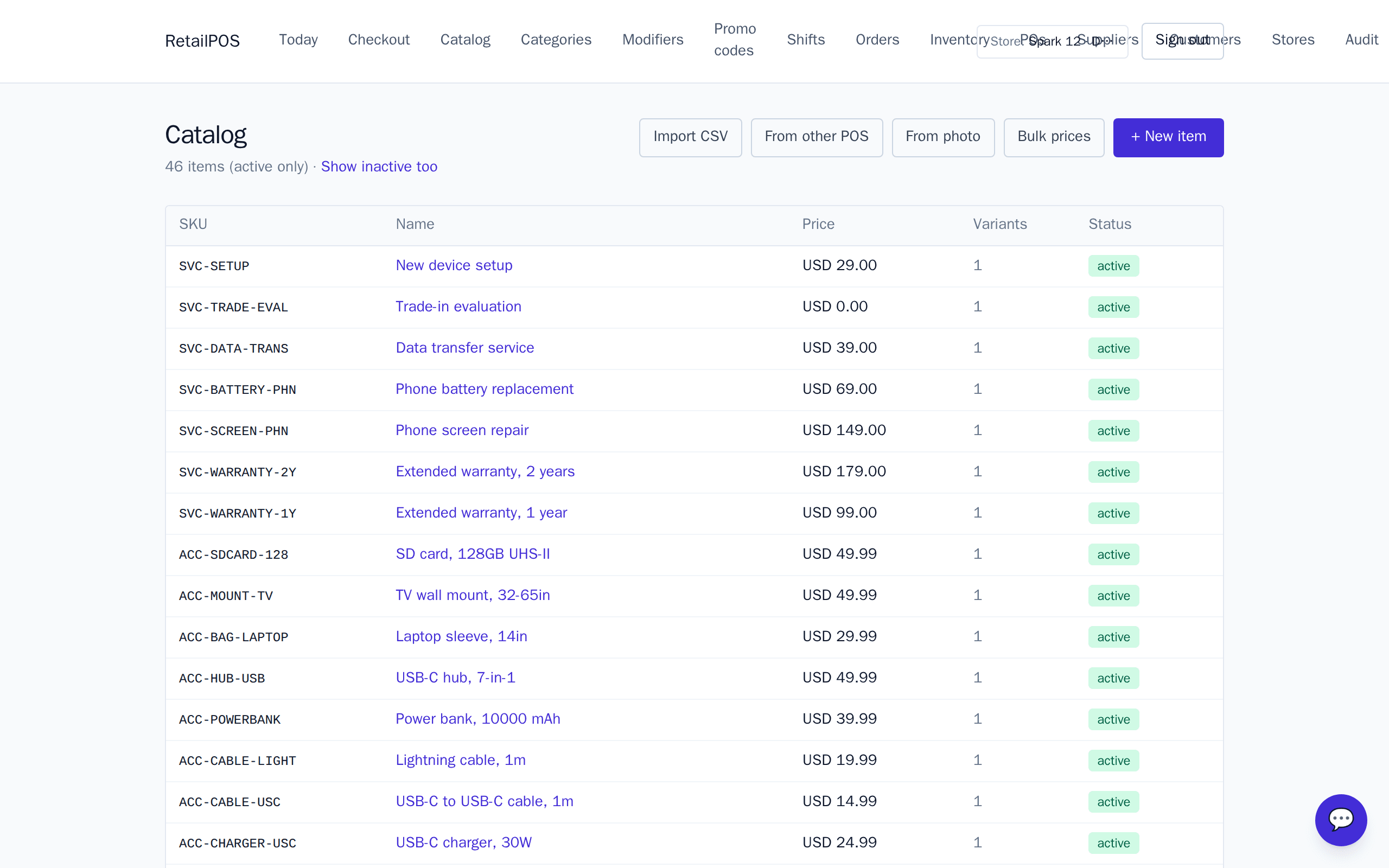
- •7 service SKUs built in: 1- and 2-year extended warranty, phone screen + battery repair, data transfer, new-device setup, trade-in evaluation.
One phone, one IMEI
Sell PHN-PRO-256 — the graphite flagship on the shelf:
- unit vun_…7H2X → status: sold
- IMEI 35 8451 78 922104 1
- warranty SVC-WARRANTY-2Y attached
- linked to order ord_…M4Q9P
The other 6 of the same SKU stay available. A walk-in returning a faulty phone — we look up the IMEI, find the exact unit row, see the original sale + warranty in one click.
Built for high-ticket electronics
- •Cashier picks the IMEI at the till. Scan the SKU; we show every available unit with its serial. Cashier taps the box in hand.
- •Look up any unit by serial. Walk-in says “sold last March” — type the IMEI, see the order, the customer, the warranty status.
- •Repair tickets reference the unit. The bench tech knows which exact laptop is in the queue, not just which model.
- •Trade-in evaluation as a service SKU; the assessed value lands as store credit on the customer record.
- •Extended warranty + bundled accessories attach to the device at sale; future repair tickets honour the warranty automatically.
- •Refurb / pre-owned units use the same machinery — the unit row records the grade and the prior history.
Where cheaper POS gives up — and how we close it
| If you're currently on… | What this pack closes for you |
|---|---|
| Lightspeed Retail (~$89-189/mo) | Strong catalogue + multi-store. Serial tracking is bolt-on (free-text field); warranty + repair ticketing need a third-party app like RepairDesk on top. |
| RepairDesk (~$50/mo) | Built specifically for the repair side. The retail front of the store usually pairs with Square; you end up with two systems and one customer database split between them. |
| Square (free + processing) | Adequate for accessory sales; no concept of per-device IMEI lookup. “Did we sell this phone?” becomes a search through six months of receipts. |
- vs Lightspeed Retail (~$89-189/mo)Strong catalogue + multi-store. Serial tracking is bolt-on (free-text field); warranty + repair ticketing need a third-party app like RepairDesk on top.
- vs RepairDesk (~$50/mo)Built specifically for the repair side. The retail front of the store usually pairs with Square; you end up with two systems and one customer database split between them.
- vs Square (free + processing)Adequate for accessory sales; no concept of per-device IMEI lookup. “Did we sell this phone?” becomes a search through six months of receipts.
Moving from Lightspeed Retail or RepairDesk?
- →Catalogue + customer list import via CSV. Active warranties (if Lightspeed exports them) become customer notes; new warranties going forward attach to the unit.
- →IMEI scanning at receive time: scan the box label, the system stores it. Bulk-import a tray of 20 phones in one minute.
- →Repair tickets in flight on the old system — let them close there. The cutover week is the right time; pause new ones a few days before, ring everything new on RetailPOS.
- →Trade-in evaluations capture as customer-record notes for V1 (store-credit-as-tender lands in a future bump).
Frequently asked questions
- Receiving a shipment of 50 phones — how long does it take?
- Five minutes. Use the scan-tray workflow: receive PO against supplier, scan each box's IMEI label; one API call commits 50 unit rows. The aisle-side scanner stays plugged in.
- How does extended warranty actually attach to a unit?
- The bundle modifier group on each phone offers “Add 2-year warranty?” The warranty SKU lands on the order line; the unit's order link is the reference. Future repair walk-ins look up the unit, see the order, see the warranty.
- What about trade-ins?
- Service SKU at $0 (SVC-TRADE-EVAL). Bench tech runs through condition / accessories / spec, captures the assessed value on the customer record. V1 records the intent; store-credit-as-tender lands with the gift-card work in a future bump.
- Can the bench tech see open repair tickets on a tablet?
- Yes. A second iPad in the bench area filters orders by open service line + intake date. Bench bumps when ready; customer-pickup ring closes the ticket.
- Pre-owned / B-grade phones — how do those track?
- Pre-owned has its own SKU (PHN-USED-PRO in the starter pack); receive units against it with the grade and prior IMEI in the unit's notes. Refurb-from-returned-unit (a returned phone becoming a B-grade unit) is a future iteration.
Recommended hardware
- •Till: iPad or laptop on the counter — built to handle the high-value-per-transaction flow.
- •Receipt printer: Star TSP143IIIBI (Bluetooth) for the customer receipt + warranty docket.
- •Barcode scanner: Honeywell Voyager 1450G (USB) — reads EAN/UPC + the small IMEI labels on phone boxes.
- •Card terminal: Stripe Reader M2 (bring-your-own Stripe; card acceptance rolling out); a higher-throughput Verifone option is available on Scale plan.
- •Bench tablet (optional): iPad in the repair bench area for ticket capture at intake + diagnosis.
New to this vertical? Read the electronics store buyer guide →
Stop losing track of devices.
Every unit has its IMEI / serial. Every repair finds it. Every warranty honours it.