← All verticalsHardware store POS
Sell by the foot and by the box — no mental math.
The cashier never reaches for a calculator. Rope by the foot, lumber by the cut, drywall screws cheaper by the hundred — sold-by-length and quantity tiers resolve themselves in the same basket, on the same ticket. The two pricing tricks every neighbourhood ironmonger needs, and the trade counter finally sorted.
$29 / store / monthMulti-store on every planWorks offline5-minute setup
What's in the Hardware starter
- •8 categories: Power tools, Hand tools, Fasteners, Plumbing, Electrical, Paint & finishes, Garden & outdoor, Lumber & cordage.
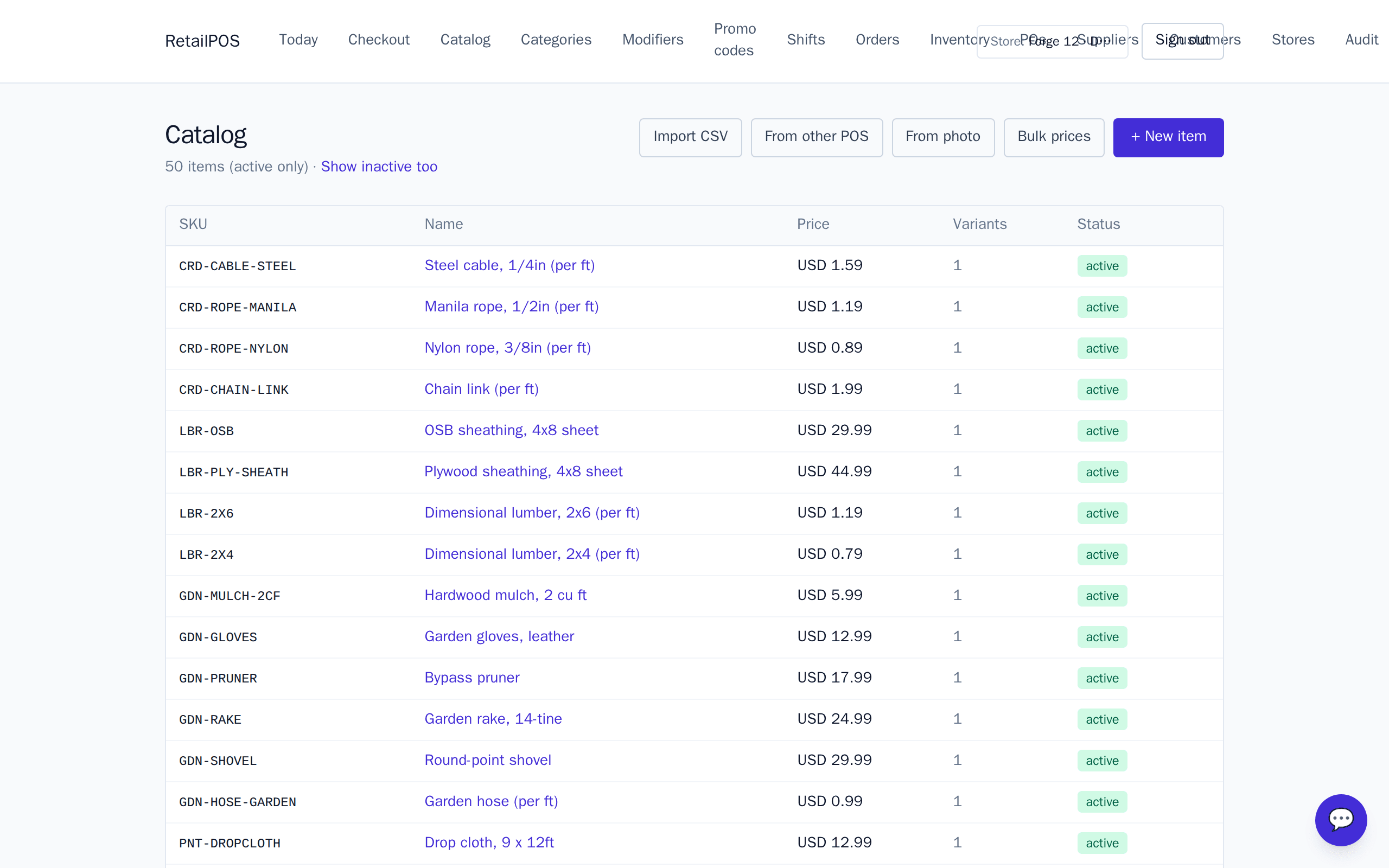
- •~50 items pre-loaded — from $0.06 washers to $145 impact drivers — a realistic small-shop mix, not a 5000-SKU dump.
- •Sold-by-length on chain link, nylon & manila rope, steel cable, garden & braided hose, 12/2 & 14/2 cable, 2x4s and 2x6s. Cashier enters the measured length at the till; price computes per foot.
- •Quantity-tier pricing on drywall screws, deck screws, common & finish nails, carriage bolts, washers, wire nuts, and paint by the 5-gallon contractor pack.
A real trade-counter sale
A contractor walks in for a deck-rail repair:
- LBR-2X4 — 24 ft @ $0.79/ft → $18.96
- CRD-ROPE-NYLON — 12 ft @ $0.89/ft → $10.68
- FST-SCREW-DECK — 150 ct @ $0.19 (tier) → $28.50
- PNT-EXT-WHITE-G — 5 gal @ $38.99 (tier) → $194.95
Single line, single ticket. The decking screws drop to the 100+ tier automatically; the paint hits the 5-gallon contractor price. The cashier doesn't look anything up.
Built for the trade counter
- •Length cashier flow. Scan the SKU; the till prompts for the cut length in the variant's unit (ft or m). Receipt prints the measurement next to the unit price for clarity.
- •Qty tiers that the customer sees. Print the next tier on the receipt (“Buy 50+ and the price drops to $0.12 each”) so a contractor knows when to round the order up.
- •Mix qty and length in one basket. A typical repair ticket carries 4-6 length lines next to a dozen qty-priced items. One basket, one tender, one receipt.
- •Receiving by the unit, selling by the foot. Buy a 500ft spool from the supplier; sell 12.5ft cuts. The cashier doesn't need to know the spool size — the till just deducts the metre/foot from the floor.
- •Trade-account holds + statement billing are deferred to a future PR — V1 is pure walk-in retail. Real-cash sale today; charge accounts post-V1.
Where cheaper POS gives up — and how we close it
| If you're currently on… | What this pack closes for you |
|---|---|
| Epicor Eagle (~$300+/mo + lease) | Capable but built for chains; legacy Windows software, multi-year contracts, separate per-module licenses. Implementation runs into months and tens of thousands. |
| NCR Counterpoint | Strong inventory + replenishment, dated UX, requires an integrator to deploy. Pricing reaches $$$$. The two-or-three-till independent shouldn't pay this much. |
| Square (free + processing) | Sold-by-length needs the cashier to compute price manually then type it in. Qty tiers are a one-off discount per ring; no auto-resolution against a tier table. |
- vs Epicor Eagle (~$300+/mo + lease)Capable but built for chains; legacy Windows software, multi-year contracts, separate per-module licenses. Implementation runs into months and tens of thousands.
- vs NCR CounterpointStrong inventory + replenishment, dated UX, requires an integrator to deploy. Pricing reaches $$$$. The two-or-three-till independent shouldn't pay this much.
- vs Square (free + processing)Sold-by-length needs the cashier to compute price manually then type it in. Qty tiers are a one-off discount per ring; no auto-resolution against a tier table.
Moving from Epicor Eagle, NCR Counterpoint, or Square?
- →SKU catalogue imports via CSV — length-priced items (chain, rope, lumber) carry their per-foot price; the system handles the multiplication at the till.
- →Qty tiers (drywall screws at three price points) configure at seed time; the seeder validates that each tier actually saves the buyer money before it imports.
- →If you're leaving Epicor: keep your barcode scanner and the Star printer. Drop the workstations — iPads cost less than your annual Epicor license.
- →Trade-account / statement billing isn't in V1 — walk-in retail today; contractors pay cash or card at the counter. Statement billing lands in a future bump.
Frequently asked questions
- Sold-by-length on chain or rope — how does the cashier flow look?
- Scan the SKU; the till shows a numeric pad labelled with the unit (ft or m). Cashier types the cut length; line price computes live as they type. Receipt prints “2.500 ft @ $1.99/ft → $4.98” for clarity.
- Quantity tiers — does the customer see the next break?
- When the line qty is within 10% of the next tier, the receipt prints “Buy N more and the price drops to $P each” — a small nudge for contractors to round the order up.
- Multi-store / aisle scanner?
- Multi-store at $69/store/month. Aisle scanner is any wireless Bluetooth barcode scanner; the cashier carries one to a contractor buying half the lumber rack.
- What about trade-account billing?
- Not in V1. Trade-account holds + monthly statements + customer-specific pricing land with the broader B2B work in a future release. Today, contractors pay at the counter.
- Lumber receiving — buy a 500ft spool, sell 12ft cuts?
- Yes. Receive the spool against your supplier (500 lands on the floor); selling 12ft decrements 12. The integer on-hand is honest about whole units; decimal stock is a follow-up for the spool / cable case where the merchant wants the 0.5ft offcut tracked too.
Recommended hardware
- •Till: iPad or laptop on the trade counter.
- •Receipt printer: Star TSP143IIIBI (Bluetooth) — prints measurement + tier hints on the receipt.
- •Barcode scanner: Honeywell Voyager 1450G (USB) — reads UPCs on tool boxes, paint cans, sheet goods.
- •Card terminal: Stripe Reader M2 (bring-your-own Stripe; card acceptance rolling out).
- •Aisle scanner (optional): a roving handheld for the contractor who is buying half the lumber rack.
New to this vertical? Read the hardware store buyer guide →
Put the calculator away for good.
Rope by the foot, screws by the box, lumber by the cut. All loaded.