Never refund the wrong piece again.
Take back the exact ring that left the case — not a guess, not the wrong stone. Every fine piece is one-of-a-kind, with its own serial number, weight, metal stamp, and certificate. Sell a ring and that exact unit leaves stock; a return finds it instantly, certificate still attached. Repair tickets and insurance valuations travel with the unit, not the SKU.
$29 / store / monthMulti-store on every planWorks offline5-minute setup
What's in the Jewellery starter
- •8 categories: Rings, Necklaces, Earrings, Bracelets, Watches, Loose stones, Care supplies, Repair & care.
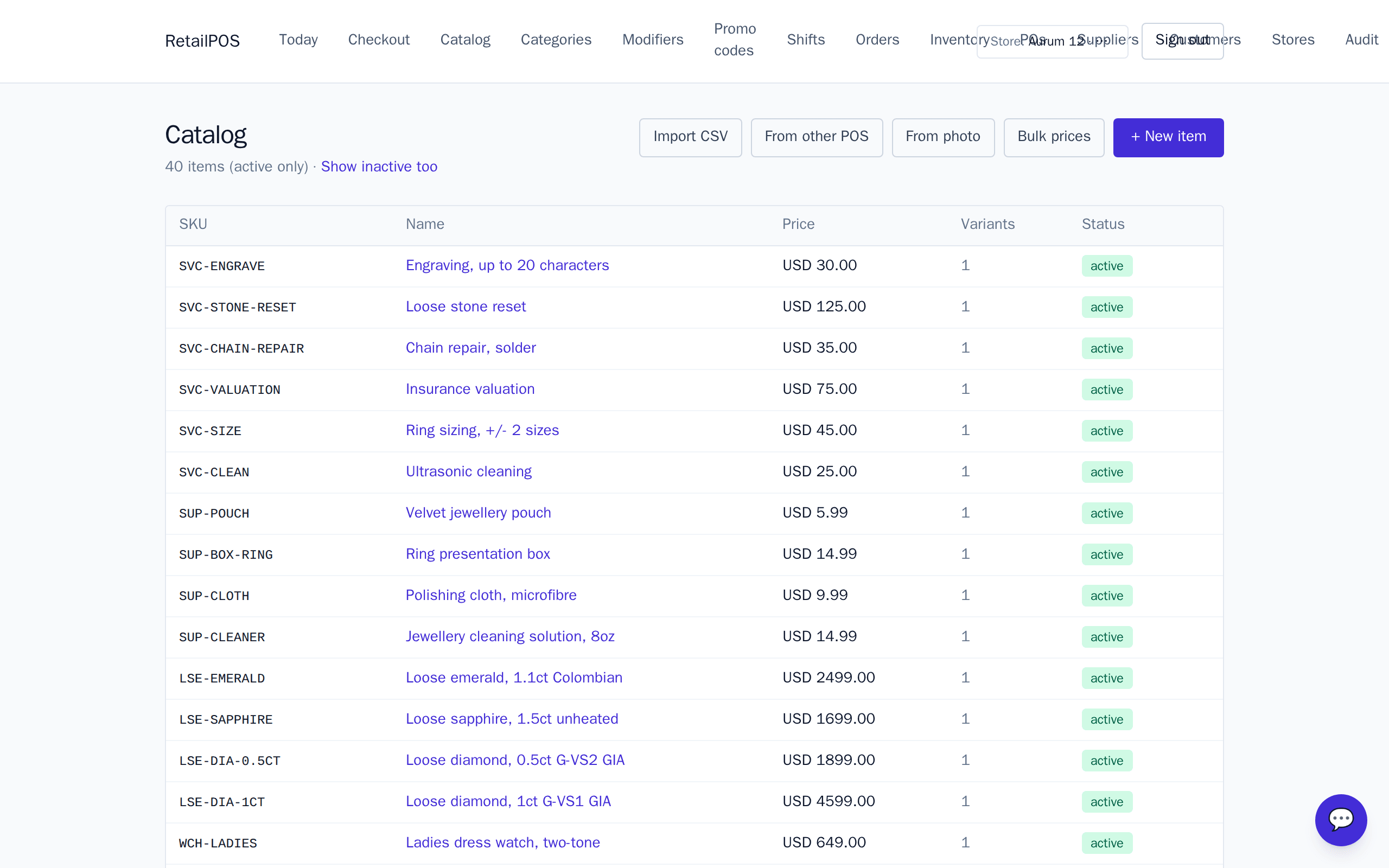
- •34 items pre-loaded — solitaires, eternity bands, tennis necklaces, swiss watches, GIA-certified loose diamonds — plus polishing cloths, presentation boxes, and 6 services.
- •Per-piece serial tracking on every fine piece. Each ring is its own unit with weight, metal, stone, and certificate on the row.
- •Repair + valuation services as labour SKUs (cleaning, sizing, valuation, chain repair, stone reset, engraving).
One ring, one unit
Sell RNG-SOL-1CT — the 1ct solitaire on the velvet tray:
- unit vun_…J92HX → status: sold
- weight 3.4g · platinum · GIA-2237481
- linked to order ord_…K01R3
The other 4 solitaires of the same SKU on the floor stay available. A return puts that exact unit back on the tray — no “which one was it?” guessing.
Designed for one-of-a-kind stock
- •Cashier picks the unit at the till. Scan the SKU; we show every available unit with its serial. Cashier taps the one in hand — the rest stay in stock.
- •Provenance survives a refund. Refund the piece, the same unit row flips back to available. Certificate stays linked.
- •Goldsmith repair tickets reference the unit, not the SKU — “vun_K9F2… — re-tip claw 3” — so the back-of-house knows which exact ring is on the bench.
- •Insurance valuation as a labour SKU with the unit attached. Customer gets a printed valuation tied to that serial.
- •Fashion + costume jewellery stays on integer stock — the seed only flips fine pieces into per-unit mode.
Where cheaper POS gives up — and how we close it
| If you're currently on… | What this pack closes for you |
|---|---|
| Lightspeed Retail (~$89-189/mo) | Variants work for size grids but not for serialised one-of-a-kind. Per-piece weight / metal / certificate go in description text where they can't drive reports or refund lookups. |
| Edge by Abbott (specialty, ~$39+/mo) | Strongest specialty option historically. Per-piece tracking is there; the broader platform (multi-location, modern API, cloud-native sync) is dated. On-premise install for many tenants. |
| Square (free + processing) | No concept of per-piece tracking. Each fine ring is a SKU you ring; the system has no idea which physical piece sold. Workable for fashion jewellery; not for fine. |
- vs Lightspeed Retail (~$89-189/mo)Variants work for size grids but not for serialised one-of-a-kind. Per-piece weight / metal / certificate go in description text where they can't drive reports or refund lookups.
- vs Edge by Abbott (specialty, ~$39+/mo)Strongest specialty option historically. Per-piece tracking is there; the broader platform (multi-location, modern API, cloud-native sync) is dated. On-premise install for many tenants.
- vs Square (free + processing)No concept of per-piece tracking. Each fine ring is a SKU you ring; the system has no idea which physical piece sold. Workable for fashion jewellery; not for fine.
Moving from Lightspeed Retail or Edge by Abbott?
- →SKU catalogue imports via CSV. Each unique piece comes in as a serial-tracked unit at receive time — the import doesn't carry units; you receive them fresh.
- →Customer list with appraisal history imports separately; valuation documents stay on the old system as PDFs you can attach to customer notes.
- →Repair queue (current tickets) — the cleanest path is to close them on the old system and start fresh on RetailPOS. Most shops time the cutover for a slow week.
- →GIA / IGI certificate numbers store in the unit's notes field for V1; a structured certificate column lands in a follow-up.
Frequently asked questions
- How does the cashier pick the exact piece at the till?
- Scan the SKU; the till pops a unit picker showing every available piece for that SKU with its serial. Cashier taps the one in hand. Two seconds.
- What about loose stones with GIA certificates?
- Each loose stone is its own unit. Certificate number, carat, cut, colour, clarity go in the unit's notes (JSON for V1; structured columns are a follow-up). The certificate PDF attaches to the unit's record.
- Repair workflow — how does it work?
- Customer drops a piece in. Create an order with a service SKU (cleaning, sizing, stone reset, etc.); add a note referencing the unit ID. The goldsmith's bench tablet pulls open service tickets ordered by intake time. Charges at pickup.
- Layaway — does it ship with the jewellery pack?
- The payment-plan primitive ships in the platform layer (used by furniture). The jewellery cashier UI for it lands in a future bump; today, manage holds with a sticker on the case and ring the deposit through the existing tender flow.
- Insurance valuations — can we print one?
- Yes — “Insurance valuation” is a service SKU at $75 (configurable). The receipt doubles as a printed valuation tied to the unit's serial + certificate. Stamped, signed, customer takes it to the insurer.
Recommended hardware
- •Till: iPad or laptop at the showroom counter — security matters; we don't put the till on the customer side of the case.
- •Receipt + valuation printer: Star TSP143IIIBI (Bluetooth) for receipts; the same paper roll handles printed valuations on demand.
- •Card terminal: Stripe Reader M2 (bring-your-own Stripe; card acceptance rolling out) for cards over the counter.
- •Display case scanner (optional): Honeywell Voyager 1450G — every piece has a printed tag with its SKU + serial QR.
- •Workshop tablet (optional): small iPad in the goldsmith's back room for repair ticket capture.
New to this vertical? Read the jewellery shop buyer guide →
Stop guessing which ring is which.
Never refund the wrong piece or lose a certificate — every ring, stone, and watch is tracked as its own unit, with its own serial.